
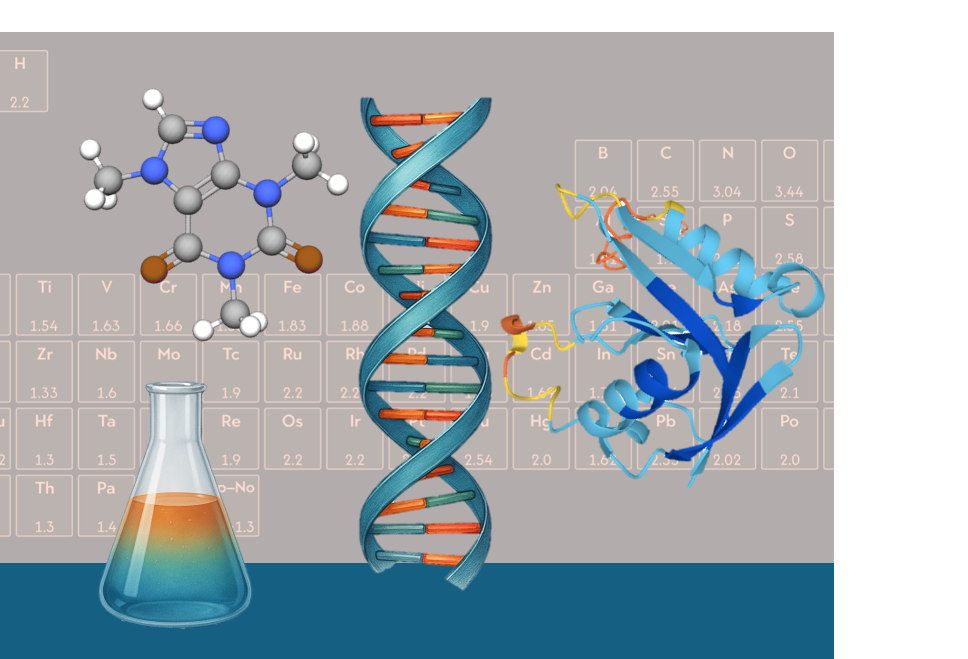
This course provides an integrated introduction to general, organic, and biological chemistry, designed primarily for students pursuing careers in health-related fields such as nursing, allied health, or nutrition. The courseware can be modified to fit a one or two semester sequence.
General, Organic, and Biological Chemistry
- Description
- What students will learn
- Learning objectives by module
- Course assessments, activities, and outline
- Other course details
- System requirements
- Included instructor tools
Description
This course provides an integrated introduction to general, organic, and biological chemistry, tailored for students pursuing careers in health-related fields such as nursing, allied health, or nutrition. It covers fundamental topics including atomic structure, chemical bonding, reactions, states of matter, solutions, acids and bases, and the principles of organic and biochemical processes. Emphasis is placed on the relevance of chemistry to biological systems and human health, with practical applications in physiology, pharmacology, and metabolism.
The courseware is designed to offer contextualized, engaging content presented in a logical sequence. It features smooth transitions between concise expository text, worked examples, interactive activities, simulations, and multimedia elements. This dynamic structure supports active learning and helps students build a deeper understanding of chemical principles through real-world context and application.
What students will learn
By the time they finish this course, students will learn or be able to:
- Describe and apply basic principles of general chemistry in organic and biological contexts, including atomic and molecular structure, chemical reactions, nuclear chemistry, solutions, intermolecular forces and acids and bases.
- Interpret and use chemical notation, including formulas, equations, and nomenclature for inorganic, organic, and biochemical compounds.
- Explain the structure, properties, and reactions of organic molecules, with a focus on functional groups relevant to biological systems (e.g., alcohols, acids, esters, amines).
- Identify and describe the roles of biomolecules such as carbohydrates, lipids, proteins, and nucleic acids in human physiology and metabolism.
Learning objectives by module
Part 1: General Chemistry
Unit 1, Matter, Measurement and Energy
Module 1, Basic Concepts of Matter
- Describe the three states of matter.
- Classify matter as element, compound or mixture.
- Describe physical and chemical changes and properties.
Module 2, Measurements
- Use the International System of Units for measurements.
- Record measurements and calculations using the correct number of significant figures.
- Determine the accuracy and precision of sets of data.
- Convert units using dimensional analysis.
- Determine the density of a substance.
- Calculate medication dosages based on patient-specific factors, such as weight and prescribed dosage guidelines.
Module 3, Energy, Heat and Temperature
- Distinguish between kinetic and potential energy.
- Recognize the relationship between heat, temperature and kinetic energy.
- Distinguish between exothermic and endothermic reactions.
- Convert among the temperature scales of Fahrenheit,Celsius, and Kelvin.
- Convert among units of energy.
- Apply the specific heat equation to solve for unknown variables.
Unit 2, Atomic Structure and Nuclear Chemistry
Module 4, Atomic Structure and the Periodic Table
- Describe the structure of the atom and its subatomic particles.
- Describe the arrangement of the periodic table of elements.
- Interpret chemical symbols for isotopes and ions.
- Apply the concepts of isotopes and their percent abundance to perform calculations related to atomic mass.
Module 5, Arrangement of Electrons
- Describe the arrangement of electrons in an atom with electron configurations and orbital diagrams for elements.
- Determine numbers of valence electrons for main-group elements.
- Compare relative sizes and ionization energies of atoms of different elements.
Module 6, Nuclear Chemistry
- Explain and use mathematical relationships among frequency, wavelength, and energy to analyze electromagnetic radiation.
- Write nuclear equations for alpha, beta and gamma radioactive decay.
- Apply the concept of half-life to calculate the time for radioactive decay and the remaining mass of an isotope over time.
- Analyze the effects of radiation exposure and apply principles of nuclear chemistry to explain the medical and biological applications of radioisotopes.
Unit 3, Ionic and Molecular Bonding and Compounds
Module 7, Ionic and Molecular Bonding and Compounds
- Describe ionic and covalent bond formation.
- Write electron configurations for ions.
- Name and write chemical formulas for compounds.
Module 8, Structure of Molecular Compounds
- Recognize differences between molecular and structural formulas.
- Draw Lewis structures depicting the bonding in molecules.
- Assess the polarity of covalent bonds.
Module 9, Molecular Structure and Polarity
- Predict the structure of molecules using valence shell electron pair repulsion (VSEPR) theory.
- Assess the polarity of a molecule based on its bonding and structure.
Unit 4, Chemical Reactions
Module 10, Chemical Reactions and Equations
- Represent chemical reactions with chemical equations.
- Classify chemical reactions.
- Predict the products of chemical reactions.
- Describe oxidation-reduction reactions.
Module 11, Mole Conversions
- Convert amounts of substances among moles, particles and mass.
Module 12, Quantities in Chemical Reactions
- Apply stoichiometric relationships to calculate amounts of substances involved in chemical reactions.
- Identify limiting reactants in chemical reactions.
- Calculate the percent yield of a chemical reaction.
- Distinguish between exothermic and endothermic reactions.
Unit 5, Solids, Liquids and Gases
Module 13, States of Matter and Intermolecular Forces
- Compare and contrast intermolecular and intramolecular forces.
- Explain how temperature affects the strength of intermolecular forces and determines the state of matter of a substance.
- Predict and explain differences in melting points and boiling points of ionic and molecular compounds.
Module 14, Gases
- Describe the relationship between the kinetic molecular theory and gas laws.
- Calculate pressure, temperature, volume, or amount of gas by applying the appropriate gas law.
Unit 6, Solutions
- Learning Objectives Available Soon
Module 15, Overview of Solutions
Module 16, Concentrations of Solutions
Unit 7, Reaction Rates and Equilibrium
- Learning Objectives Available Soon
Module 17, Basic Concepts of Equilibrium and Reaction Rates
Module 18, Le Chatelier’s Principle and Equilibrium Calculations
Unit 8, Acids and Bases
- Learning Objectives Available Soon
Module 19, Defining and Measuring Acids and Bases
- Learning Objectives Available Soon
Module 20, Strong and Weak Acids and Bases
- Learning Objectives Available Soon
Module 21, Buffers
- Learning Objectives Available Soon
Part 2, Organic Chemistry
Unit 1, Overview of Organic Chemistry
Module 1, Overview of Organic Chemistry
- Determine whether a substance is an organic compound based on its chemical formula.
- Write Lewis structures for organic compounds.
- Explain the importance of functional groups and recognize their common representations.
- Classify oxygen-containing functional groups.
- Classify nitrogen-containing functional groups.
Unit 2, Hydrocarbons
Module 2, Alkanes
- Translate between structural, condensed and line formulas for alkanes.
- Apply the IUPAC rules to name straight-chain, branched and cyclo alkanes.
- Analyze structures to determine if they are isomers or non-isomers.
Module 3, Alkenes, Alkynes and Aromatics
- Apply the IUPAC rules to name alkenes, alkynes and aromatics.
- Describe the molecular structure of alkenes, alkynes and aromatics.
Module 4, Properties and Reactions of Hydrocarbons
- Learning Objectives Available Soon
Unit 3, Oxygen and Nitrogen Containing Organic Compounds
- Learning Objectives Available Soon
Module 5, Alcohols and Ethers
- Learning Objectives Available Soon
Module 6, Aldehydes and Ketones
- Learning Objectives Available Soon
Module 7, Carboxylic Acids and Esters
- Learning Objectives Available Soon
Module 8, Amines and Amides
- Learning Objectives Available Soon
Unit 4, Biological Macromolecules
- Learning Objectives Available Soon
Module 9, Carbohydrates
- Learning Objectives Available Soon
Module 10, Lipids
- Learning Objectives Available Soon
Module 11, Amino Acids and Proteins
- Learning Objectives Available Soon
Module 12, Enzymes
- Learning Objectives Available Soon
Module 13, Nucleic Acids
- Learning Objectives Available Soon
Unit 5, Metabolism
Module 14, Metabolism and Energy
- Learning Objectives Available Soon
Module 15, Metabolism of Carbohydrates
- Learning Objectives Available Soon
Module 16, Metabolism of Lipids and Amino Acids
- Learning Objectives Available Soon
Course assessments, activities, and outline
Each module concludes with a comprehensive module checkpoint.
Part 1: General Chemistry
Unit 1, Matter, Measurement and Energy
Module 1, Basic Concepts of Matter
Module 2, Measurements
Module 3, Energy, Heat and Temperature
Unit 2, Atomic Structure and Nuclear Chemistry
Module 4, Atomic Structure and the Periodic Table
Module 5, Arrangement of Electrons
Module 6, Nuclear Chemistry
Unit 3, Ionic and Molecular Bonding and Compounds
Module 7, Ionic and Molecular Bonding and Compounds
Module 8, Structure of Molecular Compounds
Module 9, Molecular Structure and Polarity
Unit 4, Chemical Reactions
Module 10, Chemical Reactions and Equations
Module 11, Mole Conversions
Unit 5, Solids, Liquids and Gases
Module 13, States of Matter and Intermolecular Forces
Module 14, Gases
Unit 6, Solutions
Module 15, Overview of Solutions
Module 16, Concentrations of Solutions
Unit 7, Reaction Rates and Equilibrium
Module 17, Basic Concepts of Equilibrium and Reaction Rates
Module 18, Le Chatelier’s Principle and Equilibrium Calculations
Unit 8, Acids and Bases
Module 19, Defining and Measuring Acids and Bases
Module 20, Strong and Weak Acids and Bases
Module 21, Buffers
Part 2, Organic Chemistry
Unit 1, Overview of Organic Chemistry
Module 1, Overview of Organic Chemistry
Unit 2, Hydrocarbons
Module 2, Alkanes
Module 3, Alkenes, Alkynes and Aromatics
Module 4, Properties and Reactions of Hydrocarbons
Unit 3, Oxygen and Nitrogen Containing Organic Compounds
Module 5, Alcohols and Ethers
Module 6, Aldehydes and Ketones
Module 7, Carboxylic Acids and Esters
Module 8, Amines and Amides
Part 3, Biological Chemistry
Unit 4, Biological Macromolecules
Module 9, Carbohydrates
Module 10, Lipids
Module 11, Amino Acids and Proteins
Module 12, Enzymes
Module 13, Nucleic Acids
Unit 5, Metabolism
Module 14, Metabolism and Energy
Module 15, Metabolism of Carbohydrates
Module 16, Metabolism of Lipids and Amino Acids
Other course details
The current courseware comprehensively covers all topics at a depth suitable for a two-semester course, but it is also designed to be adaptable for a one-semester format when necessary.
August 2025
NOTE: General Chemistry (Part 1) will be available in Fall 2025. The complete course—General (Part 1) and Organic and Biological Chemistry (Part 2)—will be released in Spring 2026.
The General Chemistry portion is adapted from OLI General Chemistry (which was originally adapted from OpenStax General Chemistry), while the Organic and Biological sections are based on The Basics of General, Organic, and Biological Chemistry. Ball, Hill and Scott, 2011.
Core Development Team
- Dhaval Doshi (Mt. San Antonio College)
- Sandra Raysor (Carnegie Mellon University)
- Colleen Kelley (University of Arizona)
- Gino Romeo (Yavapai College)
- Pollyanna Wikrent (Pima College)
- Cuiwen He (Mt. San Antonio College)
- Steven Bernard (Mt. San Antonio College)
- Michael Marsella (Mt. San Antonio College)

This work is licensed under a Creative Commons Attribution-NonCommercial-ShareAlike 4.0 International License.
System requirements
OLI system requirements, regardless of course:
- internet access
- an operating system that supports the latest browser update
- the latest browser update (Chrome recommended; Firefox, Safari supported; Edge and Internet Explorer are supported but not recommended)
- pop-ups enabled
- cookies enabled
Some courses include exercises with exceptions to these requirements, such as technology that cannot be used on mobile devices.
This course’s system requirements:
Cost and payment options
$25 per student
Students are prompted for payment during the OLI course registration process, and can pay with a credit card or an OLI Payment Code purchased from your campus bookstore.
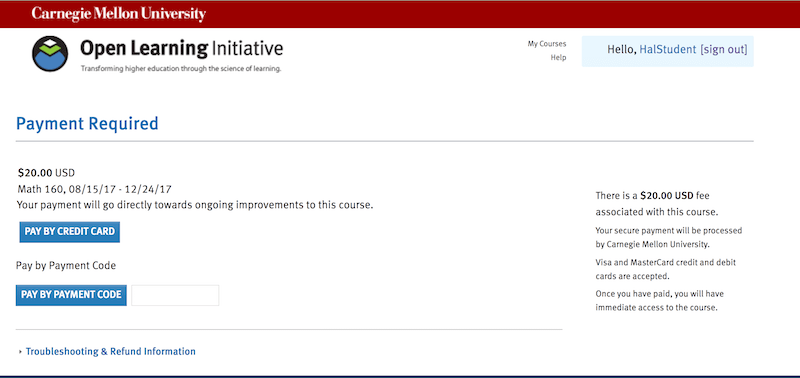
Bulk discounts and alternative payment arrangements are available, including institutional or departmental payments. Learn about discounts and payment options.
Included instructor tools
Instructors who teach with OLI courses benefit from a suite of free tools, technologies, and pedagogical approaches. Together they equip teachers with insights into real-time student learning states; they provide more effective instruction in less time; and they’ve been proven to boost student success.
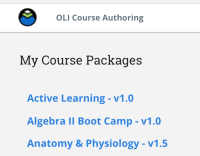
If you’d like to update an OLI course for your students, or even develop a new course or program of study, contact OLI Support for information about the OLI Author platform.
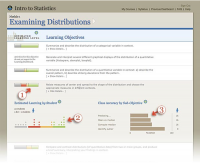
Learning and participation data is displayed in the Learning Dashboard. Read more.

Learning Engineering is the virtuous cycle of iterative improvement of learning content, instructional technologies, and the greater scientific research community. Read more
OLI courses can be deployed with preferences in dozens of areas, including: