
This is a mini-course for individuals with no or extremely limited knowledge of Arabic language and culture who are about to begin study or work in an Arabic-speaking context. It will introduce basic concepts and information to facilitate entry and engagement.
Arabic for Global Exchange
$25
- Description
- What students will learn
- Learning objectives by module
- Course assessments, activities, and outline
- Other course details
- System requirements
- Included instructor tools
Description
Arabic for Global Exchange is a course in Arabic language and culture that utilizes cognitive learning technologies and computer-assisted language instruction to enhance educational, governmental, and business exchanges that are increasingly vital to public policy and economic development in the global economy. This is a mini-course for individuals with no proficiency or extremely limited knowledge of Arabic language and culture who are about to begin study or work in an Arabic-speaking context.
The course introduces learners to basic concepts and information to facilitate entry and engagement in an Arabic-speaking environment. The Arabic for Global Exchange project aims to meet a need for high quality, communication-oriented instructional materials to introduce basic cultural knowledge and survival language.
Arabic for Global Exchange is a six-week, six-lesson, half-semester course (equivalent of six weeks of university-level instruction), or roughly sixty hours of student effort. The course will be available in two formats: one a controlled-access version for students taking the course for academic credit, and the other, a free and open version for independent learners on the Internet. Each of the six lessons in the course includes texts and activities to promote acquisition of cultural content in English as well as basic introductory exposure to the Arabic language.
Cultural content
Cultural content invites exploration of topics and learning objectives in six complementary areas.
- Lesson 1: The Diversity of the Arabic-Speaking World
Introduces students to the changing demographics and diversity of the Arab World. - Lesson 2: Historical Aspects of Islam
Guides students to learn background information on the history of Islam in the Middle East and consider the role that the religion plays in everyday life in society. - Lesson 3: Political Governance
Introduces students to political systems of the Arab World. - Lesson 4: Family and Society
Guides students to explore the institution and importance of the family, the empowerment deficit that women face, and the symbolism of wearing the hijab. - Lesson 5: America and The Arab World
Introduces students to the complexities of the Arab World’s relationship with the West seen through many of the society-shaping political, economic, and social issues that resonate in the Arab World today. - Lesson 6: The Suk, the Ahwa, and a Bowl of Fresh Hummus
Highlights places in the Arabic-speaking world of beauty, rich culture, and excitement.
Linguistic content
Linguistic content provides a brief introduction to the Arabic Language through focus on the following general topics and subtopics
- Lesson 1/ Greetings! Marhaba!
- Lesson 2/ Eating Out and Shopping
- Lesson 3/ Visit to a Home in the Arabic-Speaking World
- Lesson 4/ Traveling to an Arabic-Speaking Country
- Lesson 5/ Professional Meetings
- Lesson 6/ Common Expressions in Arabic
Through a variety of activities and practice exercises, the course fosters students’ engagement with diverse texts and multimedia resources including visual art, essays, literary works, position papers, articles from magazines and newspapers, photos, interviews, songs, and film clips, etc.
What students will learn
Students will learn about:
- Diversity in the Arabic-speaking world.
- Historical aspects of Islam.
- Political governance.
- Family and society.
- America and the Arab world.
- Places in the Arabic-speaking world of beauty, rich culture, and excitement.
Students will learn communication used for:
- Greetings.
- Eating out and shopping.
- Visiting a home in the Arabic-speaking world.
- Traveling to an Arabic-speaking country.
- Professional meetings.
- Common expressions in Arabic.
Learning objectives by module
Lesson 1: The Diversity of the Arabic-Speaking World/Greetings! Marhaba! مرحبا
- Greetings! Marhaba! مرحبا
- Greetings in Arabic
- How to introduce oneself
- The feminine marker
- The Diversity of the Arabic-Speaking World
- Be exposed to the differences between classical and colloquial Arabic.
- Gain a basic exposure to the diversity of the Arabic-speaking world.
- Gain an appreciation for the demographics of the Arabic-speaking world and the inherent state of flux that the region faces.
Lesson 2: Religion in the Arab World
- Eating Out
- Different kinds of food
- Eating out in the Arab world
- Form nationalities/adjectives from country names
- Numbers
- Ordering food
- Tipping
- Religion in the Arab World
- Learn about Ramadan and understand its cultural significance in the Arabic-speaking world.
- Learn about some of the practices of Islam and the idea of Islam being a “full system” for some Muslims.
- Learn about the historic roots of the birth and spread of Islam, including the split between Sunnis and Shia.
Lesson 3: Family and Society/Visit to a Home in the Arabic-Speaking World
- Family and Society
- Be exposed to aspects of the empowerment deficit that women face in the Arabic-speaking world.
- Gain an introduction to the arguments surrounding wearing the hijab.
- Gain background on the role of the family in the Arabic-speaking world.
- Visit to a Home in the Arabic-Speaking World
- Polite conversation
- The etiquette of interacting with Arabs: socializing, sharing meals
- What to say and what to do
Lesson 4: Political Governance/Travelling to an Arabic-Speaking Country
- Political Governance
- Gain a context for understanding the recent developments of the “Arab Spring.”
- Gain an idea of the complicated day-to-day decisions of living amid corruption and under authoritarian rule.
- Gain exposure to the historic and current problems of governance in the Arabic-speaking world.
- Travelling to an Arabic-Speaking Country
- Go through Immigration in an Arab airport
- Numbers 20-100
- Take a cab
- The names of Arab countries and their capital cities
Lesson 5: America and the Arab World/Formal Meetings
- America and the Arab World
- Be exposed to some of the positive influences that the West has offered the Arab world and that the Arab world has adapted as its own.
- Explore the historical background of the Arab-Israeli conflict.
- Gain a basic understanding of some of the historical, political, and cultural factors that lead to complicated relations between the Arab world and the West.
- Formal Meetings
- Expressions relating to polite and formal greetings and conversation in a professional office
Lesson 6: Mūsīqā to Your Ears and Eyes!/Shopping in a Suk
- Mūsīqā to Your Ears and Eyes!
- Gain a basic exposure to some of the Arab world’s most prominent cultural figures in Arabic music of the last 50 years.
- Get a taste of some of the lesser covered but more beautiful historic, cultural, and social aspects of the Arab world.
- Shopping in a Suk
- Learn terms of endearment as heard in Arabic music, and terms of respect.
- Review vocabulary used when shopping in a suk.
Course assessments, activities, and outline
Introduction
Lesson 1: The Diversity of the Arabic-Speaking World/Greetings! Marhaba! مرحبا
The Diversity of the Arabic-Speaking World
Greetings! Marhaba! مرحبا
Test: Lesson 1
Lesson 2: Religion in the Arab World
Religion in the Arab World
Eating Out
Test: Lesson 2
Lesson 3: Family and Society/Visit to a Home in the Arabic-Speaking World
Family and Society
Visit to a Home in the Arabic-Speaking World
Test: Lesson 3
Lesson 4: Political Governance/Travelling to an Arabic-Speaking Country
Political Governance
Travelling to an Arabic-Speaking Country
Test: Lesson 4
Lesson 5: America and the Arab World/Formal Meetings
America and the Arab World
Formal Meetings
Test: Lesson 5
Lesson 6: Mūsīqā to Your Ears and Eyes!/Shopping in a Suk
Mūsīqā to Your Ears and Eyes!
Shopping in a Suk
Test: Lesson 6
Other course details
This is a six-week, six-lesson, half-semester course (equivalent to six weeks of university-level instruction) or roughly sixty hours of student effort.
Month, 201X
Co-Principal Investigators
- Dr. Susan G. Polansky
- Dr. Christopher M. Jones
Co-Authors
- Benjamin Orbach
- Amani Attia
- Nevine Abraham
Contributing Authors
- Abdesalam Soudi
- Rasha W. Al-Hashimi
- Elena Marusak
Technical Lead
- Marc Siskin
Materials Research
- Jessica Goodman
XML Coding & Proofing
- Jawad Damir
- Elena Marusak
Voice Talent
- Rasha Al-Hashimi
- Hanae Timoulali
- Ziad H. Ewais
- Ethan Pullman
- Louie Al-Hashimi
- Elena Marusak
- Abdesalam Soudi
Funding Credits
- A Directed Grant from the U.S. Congress
- Carnegie Mellon University Department of Modern Languages

This work is licensed under a Creative Commons Attribution-NonCommercial-ShareAlike 4.0 International License.
System requirements
OLI system requirements, regardless of course:
- internet access
- an operating system that supports the latest browser update
- the latest browser update (Chrome recommended; Firefox, Safari supported; Edge and Internet Explorer are supported but not recommended)
- pop-ups enabled
- cookies enabled
Some courses include exercises with exceptions to these requirements, such as technology that cannot be used on mobile devices.
This course’s system requirements:
- none listed (subject to change)
Cost and payment options
$25 per student
Students are prompted for payment during the OLI course registration process, and can pay with a credit card or an OLI Payment Code purchased from your campus bookstore.
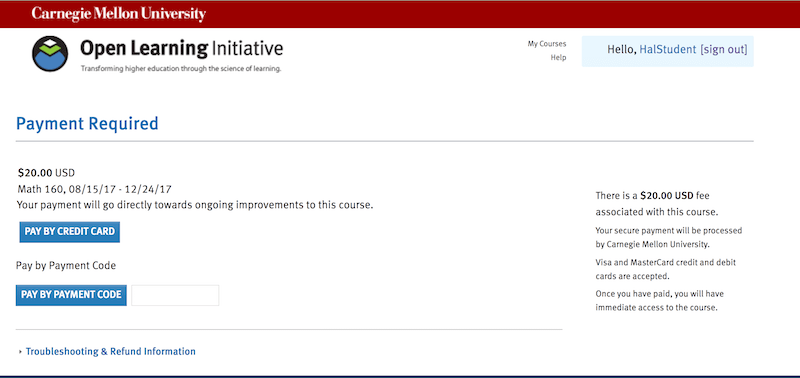
Bulk discounts and alternative payment arrangements are available, including institutional or departmental payments. Learn about discounts and payment options.
Included instructor tools
Instructors who teach with OLI courses benefit from a suite of free tools, technologies, and pedagogical approaches. Together they equip teachers with insights into real-time student learning states; they provide more effective instruction in less time; and they’ve been proven to boost student success.
If you’d like to update an OLI course for your students, or even develop a new course or program of study, contact OLI Support for information about the OLI Author platform.
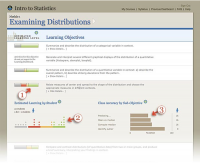
Learning and participation data is displayed in the Learning Dashboard. Read more.

Learning Engineering is the virtuous cycle of iterative improvement of learning content, instructional technologies, and the greater scientific research community. Read more
OLI courses can be deployed with preferences in dozens of areas, including: