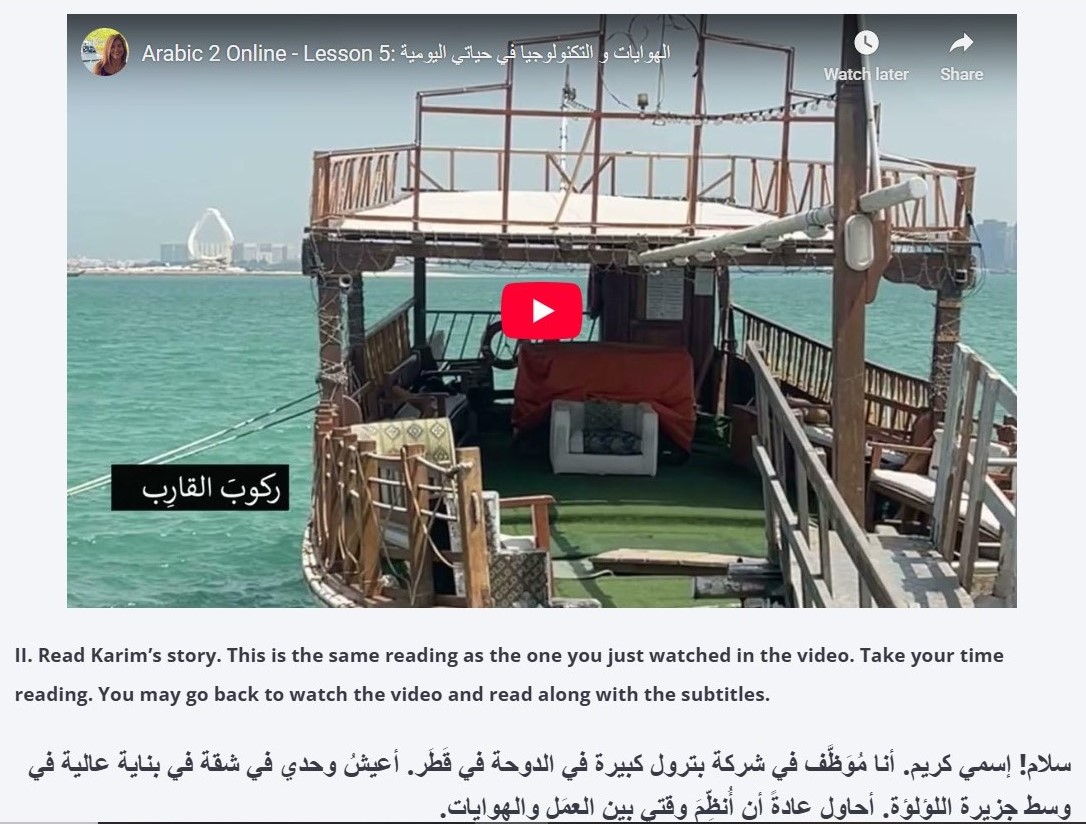
Second-semester Arabic course that teaches Modern Standard Arabic, the Egyptian and Levantine dialects, and Arab culture.



$50
Second-semester Arabic course that teaches Modern Standard Arabic, the Egyptian and Levantine dialects, and Arab culture.
Elementary Arabic 2 is designed for second-semester beginning Arabic learners who completed first-semester Arabic or its equivalent, have basic knowledge of Modern Standard Arabic, and wish to continue building their communicative competence at the elementary level in Modern Standard Arabic (MSA) and the Egyptian and/or Levantine dialects.
Using a proficiency-oriented approach, learners will
The course structure consists of 5 theme-based, contextualized lessons that can be completed over the duration of 14 or 15 weeks. Each lesson consists of
All exercises and assessments can be submitted on Torus, and many of them are auto-corrected with automatic feedback.
Using a proficiency-oriented approach, learners will
COMING SOON.
Listed under “Description” above.
Estimated time to complete: one semester.
January 2026

This work is licensed under a Creative Commons Attribution-NonCommercial-ShareAlike 4.0 International License.
OLI system requirements, regardless of course:
Some courses include exercises with exceptions to these requirements, such as technology that cannot be used on mobile devices.
This course’s system requirements:
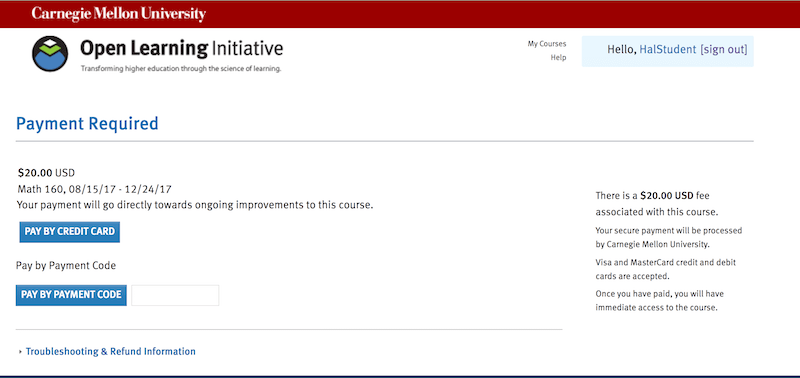
Students are prompted for payment during the OLI course registration process, and can pay with a credit card or an OLI Payment Code purchased from your campus bookstore.
Bulk discounts and alternative payment arrangements are available, including institutional or departmental payments. Learn about discounts and payment options.
Instructors who teach with OLI courses benefit from a suite of free tools, technologies, and pedagogical approaches. Together they equip teachers with insights into real-time student learning states; they provide more effective instruction in less time; and they’ve been proven to boost student success.
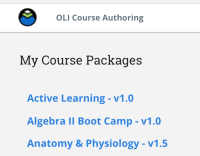
If you’d like to update an OLI course for your students, or even develop a new course or program of study, contact OLI Support for information about the OLI Author platform.
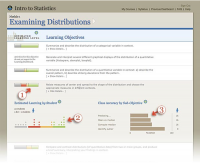
Learning and participation data is displayed in the Learning Dashboard. Read more.

Learning Engineering is the virtuous cycle of iterative improvement of learning content, instructional technologies, and the greater scientific research community. Read more
OLI courses can be deployed with preferences in dozens of areas, including: