Loading...

French 3 & 4 — Independent Learners (self-paced)

$25

Self-paced third- and fourth-semester course teaching the French language and culture, for self-starting students with an intense desire to learn the language.

Independent paid OLI courses are self-paced with no instructor, no tests, no certificate, no credits. 

Description

French 3 & 4 is a carefully sequenced and highly interactive presentation of French language and culture in a media-rich course environment. It presents an integrated approach to studying by zooming in and out across three Francophone cities: Pointe-à-Pitre in Guadeloupe, Lyon in France, and Montréal in Québec. Each lesson centers authentic video resources and textual documents. Each lesson is introduced with a Micro-trottoir video, or short interviews with locals about their everyday life. Other lesson videos include Un.e expert.e parle, in which students listen to experts like professors, museum directors, musicians, and politicians talk about their expertise on themes like public transportation, history, language and identity, race, and music. Finally, you will experience Entre amis videos, in which friends converse about their daily lives (e.g., deciding where to go to dinner, discussions while watching a hockey match).

The course includes literary and cultural reading and analysis, listening comprehension activities, grammar, and intensive practice activities in written and spoken French. This course explores the history, transportation, music, foods, and architecture of Francophone cities with an aim to foster cross-cultural awareness and self-realization while developing proficiency in French.

To successfully use this course, you should be a motivated student with a sincere desire to learn about French language and francophone cultures, and be comfortable with computer technologies.

Click here for information on studying French online vs. in person.

Independent Paid features

Independent Paid Courses

$25per student
  • Independent Paid OLI courses enable independent learners to study a subject on their own terms, at their leisure. Courses are:

    • Self-guided.
    • Self-paced.
  • Includes only the learning materials and assessments, except exercises that require human review for scoring:

    • No teacher.
    • No college credit.
    • No certificate of completion.
  • *If your teacher gave you a Course Key, do not use an Independent Paid course because your teacher will never see your work.

What students will learn

Students will:

  • Develop intermediate to advanced proficiency (B1–B2) in speaking, listening, reading, and writing French
  • Strengthen their ability to understand and interact with diverse Francophone speakers 
  • Explore Francophone cultures and societies across Guadeloupe, France, and Canada, with attention to history, foodways, music, urban life, and social issues
  • Expand their capacity to interpret authentic multimedia texts, including video, audio, and written materials
  • Communicate ideas and opinions with greater fluency, accuracy, and nuance in both spoken and written French
  • Develop intercultural awareness and critical reflection skills by comparing Francophone perspectives with their own linguistic and cultural experiences
  • Apply language skills in project-based and conversational contexts, including discussions, presentations, and video responses, tailored to their learning environment
  • Build strategies for independent learning, digital communication, and sustained engagement with French beyond the classroom

Activities

Activities include:

  • À vos marques: Activities designed to help learners activate prior knowledge, making the readings and videos in the Module easier to understand.
  • Introduction: Learners read a historical text related to the Module topic and answer comprehension questions; some Modules include additional introductory activities.
  • Le saviez-vous ?: In select Modules, learners engage with a short informational text in French that provides cultural or historical context for the Module theme.
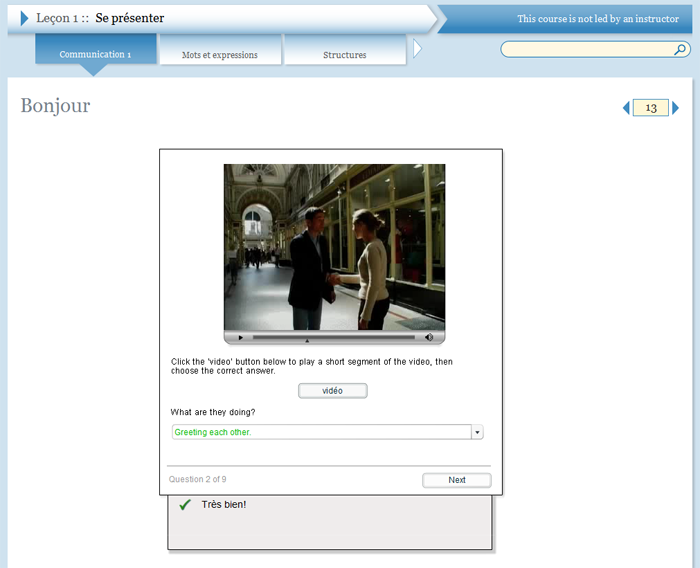
  • Vidéo : Microtrottoir: Short street-interview videos in which residents of the Unit’s city spontaneously share their perspectives on a topic, introducing learners to the theme through local voices.
  • Mots et expressions: Vocabulary sections presenting words and phrases relevant to the Module topic, accompanied by practice activities; in some Modules, vocabulary is integrated into readings or other tasks.
  • Texte(s): One to three authentic Francophone texts per Module, each paired with comprehension questions; some texts include additional follow-up activities.
  • Vidéo : Un·e expert·e parle: Interviews with one or more experts on the Module topic, offering in-depth and diverse perspectives; guidance and support activities help learners engage with the more advanced language used.
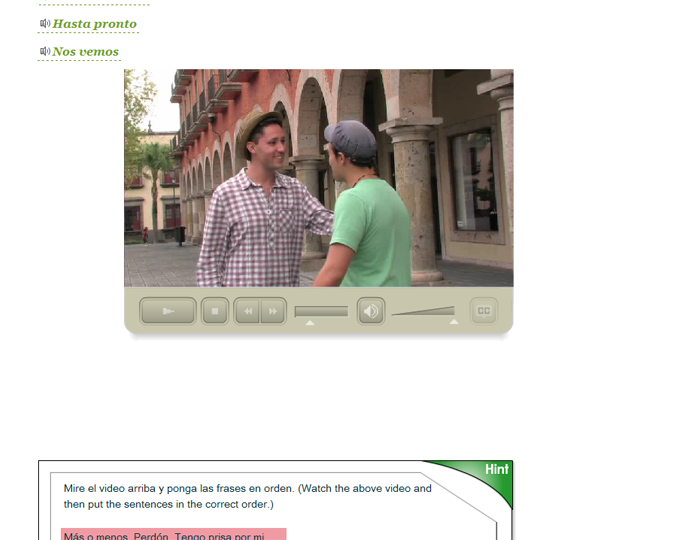
  • Vidéo : Entre amis: Skits performed by native French speakers that model how people use language, gestures, and intonation to navigate real-life situations related to the Module theme.
  • Grammaire: Two to four grammar topics per Module, linked to the Module’s content and reinforced through practice activities.
  • Interro linguistique: Assessments that test learners’ language and vocabulary knowledge.
  • À vos claviers: Creative production activities that invite learners to write in French across a range of genres, each with its own conventions; some Modules offer multiple genre options to encourage exploration and choice.

Other course details

The course is fully online. No additional materials or textbooks are required. All content is integrated into the course platform.

January 2026

Project Directors and Co-Authors

  • Dr. Christopher M. Jones
  • Dr. Sébastien Dubreil
  • Dr. Natalie Amgott

Contributing Authors

  • Natalie Amgott
  • Sébastien Dubreil
  • Christopher Jones
  • Yasmina Fawaz
  • Patricia Kyle Mosele
  • Marie Léticée
  • Mame-Fatou Niang
  • Clémence Ozel
  • Heather Pelletier
  • Sophie Queuniet
  • Brett Wells

Technical Team

  • Dylan Barclay: videographer and editor
  • Marc Siskin: online learning technologist
  • Jacob Weiss: sound engineer and editor
  • Catherine Wetmore: videographer and lead editor

Student Workers

  • Hyunji Kim
  • Emmeline Wetzel
  • Shelby Zasacky

Actors

Lyon

  • Isabelle Desmazières
  • Simon Gabillet
  • Lise Ketterer
  • Yolanda Mpelé
  • Laetitia Paris
  • Charlotte Robin
  • Johana Tixier
  • Ian Tounda

Montréal

  • Daphné Archer
  • Agnès Bouchard
  • Yannick Chapdelaine
  • Dominic de Pasquier
  • Myriam de Verger
  • Solo Fugère
  • Isabelle Grégoire
  • Jérémie Jacob Loubo
  • Jocelyn Roy

Pointe-à-Pitre

  • Sabrina Birba
  • Steve Bulgare
  • Axell Dagonia
  • Céline Forestal
  • Jérémy Hery
  • Rebecka Mulciba
  • Xavier Michaux

Funding Credits

  • Carnegie Mellon University: Language Online in the Department of Modern Languages
  • University of Texas, Austin

Acknowledgements

  • Sabrina Saada – Professor of ES, Lycée Carnot, Pointe-à-Pitre, interview
  • Marie-Ange Agneray – Professor of History, Lycée Carnot, Pointe-à-Pitre, interview
  • Natalie Bunel – interview
  • Julien Merion – Author and political scientist, interview
  • Jean-Pierre N. – Artisan, interview
  • Jean-Claude Haïkel – Businessman, interview
  • Jacques Bangou – Mayor of Pointe-à-Pitre, interview
  • Victor Jean-Noël – Coordinator of Guadeloupe Grand Large, interview
  • Nowlize Félicianne – actor and singer, interview
  • Madame Custos – community activist and film curator, interview
  • José Atela – owner, Le Petit Jardin restaurant, Pointe-à-Pitre, interview
  • Madame Roro – Vendor, Spice market, interview
  • Pierre Reinnette- principal architect of Memorial ACTe museum, interview
  • José Jerdinier – Playwright, actor, Lycée Carnot
  • Bensly – Director, Comik Kreyol Show
  • Anne-Marie and Claude-George Grimon-Prez – Courtes Lignes School of Theater, Petit Bourg
  • Fabien Arekian and family – La Maison des Vacances, Sainte-Anne
  • Henri Cassins – Owner, L’Instant Discothèque
  • Michèle Dagenais – Professor of Urban History, l’Université de Montréal, interview
  • Frédéric Bastien – Professor of History at Dawson College, interview
  • Gérard Beaudet – Professor of Urbanism and Landscape Architecture at Université de Montréal, interview
  • Chantal Bouchard – Professor of French Language and Literature, McGill, interview
  • Mauricio Segura – Writer and journalist, interview
  • Alain Contant – Lawyer, interview
  • Carl-Éric Faubert – Museum coordinator, interview
  • Kimberly Lalllouz – Chef and entrepreneur, interview
  • Gianni Contani – hockey coach, interview
  • Jenny Salgado – musician, interview
  • François Gilbert – Director of Pax Augusta, Interview
  • Isabelle Rivé – Director of the Centre d’Histoire de la Résistance et de la Déportation, interview
  • François Chambon – Architect, interview
  • Kaiama Glover – Professor of French and Africana Studies, Barnard College, interview
  • Pascal Chopin – Directeur Régional Rhône-Alpes, interview
  • Matthieu Adam – Researcher, University of Lyon, interview
  • Halim Bensaïd – CitéCréation, interview
  • Pierre et Odile Muhler – Chef and server at Les Retrouvailles restaurant, inteview

System requirements

OLI system requirements, regardless of course:

  • Reliable internet access
  • French accents input enabled
  • Audio playback capability
  • an operating system that supports the latest browser update
  • the latest browser update (Chrome recommended; Firefox, Safari supported; Edge and Internet Explorer are supported but not recommended)
  • pop-ups enabled
  • cookies enabled

Some courses include exercises with exceptions to these requirements, such as technology that cannot be used on mobile devices including tablets and phones.

This course’s system requirements:

  • If the student is working with an instructor in a distance-learning situation, chat environment and videoconferencing software.
Go to Top